Dynamic Datacenter technologies have shown significant improvement in maturity and adoption levels over the years. With the screws tightened on the IT budgets, CIOs are looking for ways to optimize their existing resource usage to meet their growing customer needs - in short they are looking for dynamic datacenter technologies (or building a private cloud). The three main pillars for building any dyanmic datacenter include - Virtualization, Auomation and Orchestration. In this post, we will discuss how the top software vendors have built solutions around the three pillars to enable the dynamic datacenter vision.
VMware:
VMware has been the undisputed leader in the virtualization space and is keen on expanding that to the Private/Public Cloud space too. So far VMware has got the most comprehensive vision to start with Dynamic Datacenter (Private Cloud) and gradually transition to Public Clouds as they start maturing. The slew of Products/partnerships that VMware has released include:
Infrastructure Virtualization : vCenter Server, vCenter CapacityIQ for fine tuning, VCE VBlocks (in partnership with Cisco and EMC)
Automation : vCenter LabManager, vCenter Lifecycle Manager
Orchestration : vCenter Orchestrator
VMware also offers Professional Services around Cloudifying your on-premise datacenter and designing strategies to adopt the Public Clouds.
Microsoft:
Microsoft, as usual, has been a late entrant to the Virtualization space and it's Hyper-V platform doesn't seem to have picked up yet - even after the R2 release. However MS has been quick to show how Hyper-V along with its rich System Center Suite can be leveraged to build your Dynamic Datacenter. The Dynamic Datacenter toolkit has the best practices to achieve this.
For MS, a lot is going to depend on the success of its Azure platform . If MS can deliver a stable and scalable Azure platform, that would speak volumes about the maturity and stability and scalability of the MS solutions. Till then - it's just Wait and Watch.
Citrix:
Citrix has gained traction over the past year with the free XenServer release and the Citrix Essentials Suite providing the automation (LabManager OEM'd from VMLogix) and orchestration ( Workflow Studio ) tools on top of the Virtualization layer. Citrix has also open sourced XenServer to attract the Cloud Service Providers. But the key area of Citrix's dominance has been Application Delivery. The Citrix Delivery Centre comprising of XenDesktop, XenApp, XenServer and Netscaler can securely and optimally deliver both Web and Desktop based applications. Citrix has also launched Virtual Appliances for its Application Delivery Controllers - Netscaler VPX - to enable flexible and automated provisioning. Will be good to see if Citrix can extend its dominance in the Application Delivery market to the Server Virtualization space too - with the Free, OpenSource XenServer.
That adds the fourth pillar to the Dynamic Datacenter story - which is Application Delivery.
The Verdict:
Based on various factors, here's the leader in each of the Dynamic Datacenter technology pieces:
Virtualization - VMware vSphere and Citrix XenServer
Though VMware would win hands down based on technology, the cost factor weights heavily in favor of XenServer. A mix of both is going to be a reality in the future.
Automation - VMLogix LabManager
The winner in this space primarily because it supports both VMware and Citrix Virtualization technologies (and MS Hyper-V too). Also has a bit of Orchestration built in it too.
Orchestration - ????
No clear winner here. Still a nascent technology and hoping some Startup can delivery some really interesting products here.
Application Delivery - Citrix Delivery Center
Citrix wins this category hands down. However some credit also goes to the F5 BIG-IP Product specifically in delivering Web Applications. But F5 still doesn't have a Virtual Appliance version of its product.
Of course, this space is set to dramatically change when VMware launches the much awaited vCloud platform. Interesting year ahead!!!
PS: All info in this post are totally my personal views only and have no bindings on my employer whoever that may be!!!
Showing posts with label vmware vCloud. Show all posts
Showing posts with label vmware vCloud. Show all posts
Wednesday, February 10, 2010

Sunday, May 3, 2009
Cloud Computing Paradigms : IaaS and PaaS
Cloud computing has created enormous buzz over the past year and different flavours of Cloud Computing have evolved.
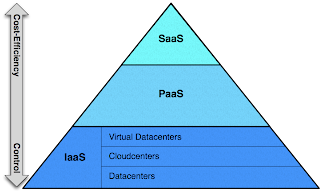
Infrastructure as a Service (IaaS):
Cloud vendors like Amazon (EC2), GoGrid and lots of other smaller players offer compute, storage and networking bandwidth resources on-Demand. Customers can dynamically provision servers and pay only for what they use.
What benefits does IaaS offer?
A lot of IT admin activities are offset to the service provider. Providers offer SLAs to guarantee uptime and over time providers would start offering value added services like automatic backup, update and patch management and multi site hosting capabilities. Don’t think any of these services are offered by any vendor today, but with VMware vCloud platform, providers should be able to offer a lot more value added services at a premium.
It also gives the flexibility to dynamically scale up /down your compute resources based on the demand. Also all the current apps running in your datacenters can be quickly migrated to the cloud without any major changes to the app itself. This has been the key reason for the success of IaaS.
But IaaS does not offer any other notable benefits to the app developers themselves. Though they can leverage the service provider APIs to quickly add new servers, they should still ensure to take care of the app scalability, load balancing and performance tuning.
Hence though IaaS might be the ideal choice for getting your current apps to the cloud, if you are building new apps for the Cloud, you might want to look at the various built in features that PaaS offers to app developers before making the choice.
Platform as a Service (PaaS):
PaaS vendors offer a framework for developers to quickly develop and deploy their apps on the cloud. For example Google App Engine offers developers to build Python and java (beta) apps and deploy them on the Google platform. MS has its azure platform to build .net apps.
What benefits does PaaS Offer:
PaaS totally negates the need for an IT admin to manage the infrastructure of your apps. The infrastructure is totally hidden and only the app development platform is exposed to the users.
Developers also are hugely benefitted by building their apps within the framework exposed by the platform. This would mean that your app can automatically scale from a few hundred users to millions of users. The app developers don't have to worry about adding more resources or performing load balancing tasks to handle the workload.
So what is the drawbacks in the PaaS Approach - First of course is that existing apps will need to be ported or actually it makes sense for only apps that are newly built. It is also going to take time for these platforms to mature and there is also the learning curve for developers to get used to the platform capabilities.
While writing up this blog post, came across the architecture diagrams of Citrix Cloud Center and VMWare vCloud. Gives me the impression that the difference between IaaS and PaaS are going to thin out in the future. Did have a argument with colleagues on whether vCloud would be an IaaS or a PaaS. Remember all the argument around para virtualization and full Virtualization. Do those terms make any sense today!!!
Subscribe to:
Posts (Atom)